
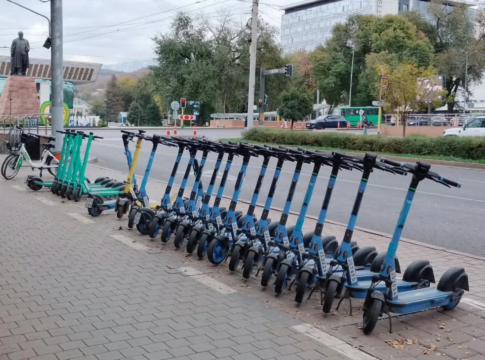
The city of Almaty has seen an enormous reduction in demand for rental e-scooters lately, fuelling casual speculation that their novelty has worn off and that people have started to identify more cons than pros.
Taking a step back in time, Santa Monica in California is widely recognised as the first city to introduce dockless rental e-scooters, which it did in 2017, soon after followed by Paris, the French capital embracing the mass migration of two-wheelers the following year.
This worked for a while. Writing in Monocle, journalist Agnès Poirier summed up why hundreds rushing at pace along a thoroughfare frequented by old people and toddlers, with that unremarkable innocent-seeming throttle pushed around to its limit, may not have been such a smart move after all.
“They [scooters] were everywhere, often piled in heaps in the middle of the pavement. The joy had gone. It became a tale of destruction, accidents and fatalities. Le Parisien reports that 1,193 people were injured by e-scooters between 2019 and 2022, and six people died.
“Hundreds [of scooters] were recovered from the Seine every year.
“Most of us had grown to hate what we at first cherished.”
In Almaty, the fresh excitement of being able to whoosh off to lunch, thus spending the elusive and magical extra three minutes with the baguette (ironically), was slowly replaced by a similar awakening, fortunately not quite on the French scale. And doubtless there are residents of the southern Kazakh city who more than grasp why Parisians chose to ditch the abusive relationship in 2023.
Agnès Poirier further explains that scooters are not the only problem, rather, a lack of careful planning before Lime, Dott, and TIER Mobility were unleashed on an unprepared city.
“If there is a lesson to be drawn from Paris’s experience with rental e-scooters, it’s that regulation should come before (rather than after) the introduction of a new mode of transport.”
In Almaty’s case, it’s not a question of too little too late, as the new legislation to avoid ending up with painful statistics as the French did is very wise. August 2026 saw the introduction of clear new rules. According to the excellent raem.kz:
Electric scooters will be banned from pavements (sidewalks) and pedestrian paths in Kazakhstan. This restriction is intended to protect pedestrians. And the police have clarified that riding [an e-scooter] on the road is permissible for adults only if in possession of a driver’s license of any category, and wearing a protective helmet. These laws are applicable to all e-scooters, whether privately owned or rented.
There is a summary of the regulations below, and while all of them seem fair to any sensible person, given that not everybody wants to take scooters onto the roads, fewer people are now venturing from A to B courtesy of the various brands whose right-angled conveyances punctuate the city centre with remarkable ubiquity.
Raem reports that there are approximately 80% fewer rides being taken, stats showing a staggering drop in rental rates – from 120,000 a day to in the region of 20,000 since the new laws came into effect.
This is no Parisian dream (but then again, by some accounts, neither is Paris these days); this is the result of scooterists not wanting to remain scooterists, partly because they don’t like the word scooterist, but also because the limits placed on where they can ride have reduced the convenience and undermined the advantage such that they no longer think it is worth it.
Two of the main companies operating in Almaty, Bolt and Jet, have experienced an enormous loss of trade, 80% and 77.8%, respectively, and while few would wish reduced profits on any honest company, safety has to come first.
Even the low 6-kph speed limit imposed by previous regulations is no longer a safeguard for vulnerable pedestrians, as the blanket ban does away with any nuanced limitation of the danger these vehicles can pose. Also in part because a speed as low as 6 kph was impractical, difficult to enforce, and many users flaunted the rules, meaning that their removal from pedestrian areas became the only way forward.
The development of the cycle-lane network, happening as fast as an Alexandr Vinokurov time-trial, is likely to result in a resumption of e-scooter use, but as to whether this much-maligned commuters’ choice will recover to previous levels or fade away into the cobbles, as it did in France, remains to be seen.
In the meantime, those wishing to rent e-scooters in Almaty should be aware of the following regulations, and even when adhering, take maximum care. The right to safety should always trump the right to speed.
| Route section | What is allowed |
| Separate bike path | You can ride without a driver’s licence. |
| Bicycle lane on the roadway | Traffic is required by law. A fastened helmet is required, as this is part of the roadway. |
| Right edge of the roadway | If there is no bike path or bike lane: 18 years of age or older, any category of driving licence and a fastened helmet. |
| Roadside | Movement is provided by law in the absence of a bike path or bike lane. |
| Sidewalk and pedestrian crossing | You need to dismount and walk the scooter alongside. |