
Sweeping society in the UK is the phrase, diversity is our strength, but the extent to which this statement has become politicised over there renders it a cliché at best, fundamentally divisive at worst, and few can utter those words, in that order, without at least a fleeting sense of awkwardness.
In Kazakhstan I can say it without hesitation, reservation, and any concern that somebody is going to pick me up for virtue signalling… diversity is our strength.
One of them, anyway.
It all stems from the fact that the highly multi-ethnic society here is not about forced integration – or bitterness at failed integration – rather, a melting pot of very different ethnic groups and cultures that don’t just respect and tolerate each other, but genuinely like sharing the same restaurants. And all the rest.
Not too far from Almaty is the vast country of China, complete with its own ethnic Kazakh community largely to be found in the west of the country. Many ethnic Kazakhs have moved to the land of their ancestors and taken citizenship, some of them becoming prominent members of society in the process.
Also crossing the same border are a number of Han Chinese, they too making their new country a permanent base and, in the vast majority of cases, offering skills and experience which are in demand in Kazakhstan.
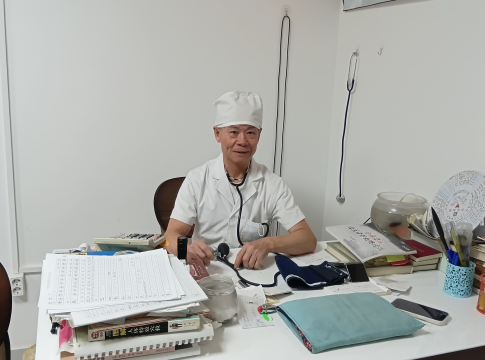
One such addition to the big family is Dr Liang, who since 2010 has worked as a traditional Chinese doctor in the city of Almaty.
It’s not the case that, given our proximity to China, Traditional Chinese Medicine (TCM) predominates as a form of medical care in the country. Although it is readily available in the major cities, it is overwhelmingly seen as an alternative, and the vast majority of patients opt for mainstream treatment. Yet, Dr Liang has built a reputation and a practice, and is regularly overbooked without the need for extensive advertising.
“I’ve been here for sixteen years. I met a resident of Almaty who introduced me to the business over here, and sorted everything out for me. I didn’t have to worry about anything: documents, plane tickets, etc. They found the translators for me, people from China.”
“I was in the city of Urumqi at the time, and working with an ethnic Kazakh, although I myself am Han Chinese. I am from the city of Chengdu, in the Sichuan Province.
“He asked me to come [to Kazakhstan]. He assessed my skills.
“From that point on, my life has been devoted to practising my art in Kazakhstan.”
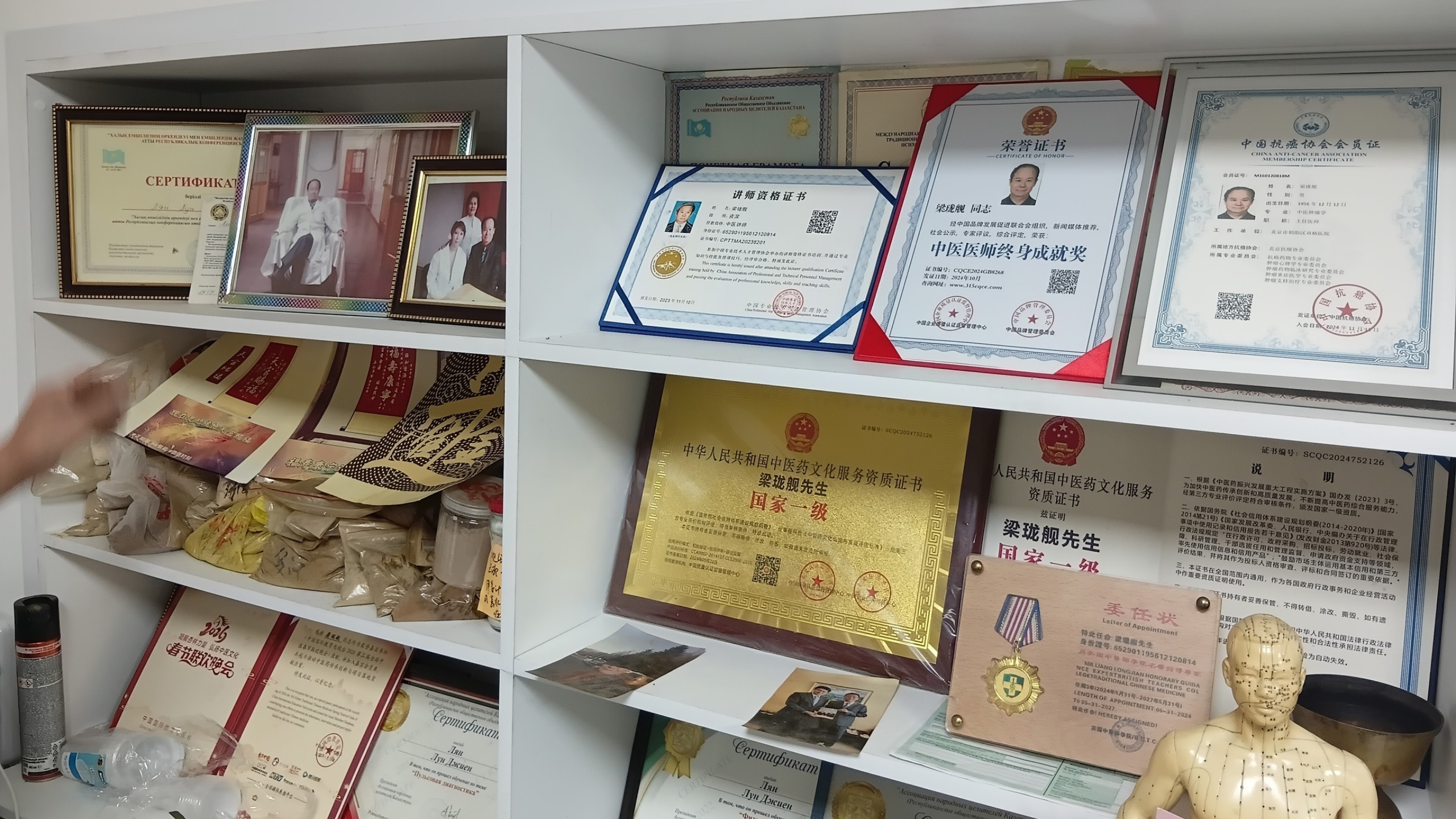
Before his time working in Urumqi, he recounted his journey into medicine and explained that his career dates back to the 1960s when his original direction was family planning, in his home town.
“I went to the Chengdu University of Traditional Chinese Medicine and spent three years there. Just three years. The diagnostic work was still there, the pathological examination was still there; it was all the same. So, after graduating, I went into clinical practice and then worked in family planning.
“I worked in specialised centres, assisting women and men with reproductive health and related medical care. My role involved providing treatment and ensuring hygiene and cleanliness standards were met in the course of that work.”
Afterwards, he opened his own clinic with a focus exclusively on traditional Chinese medicine. However, the work was repetitive and difficult, which made the situation challenging.
Later, when he heard that a mentor had taken early retirement, he relocated to Ningxia and the city of Wuhan, its second-largest city, to open his own business. He had many connections, including hospital chiefs, but in spite of this, the original plan wasn’t to remain there long.
And that’s the way it worked out. One day, soon after, he was travelling with his wife and children from Chengdu to Ningxia, but he told his family to fly back to Chengdu, and he travelled alone from Ningxia to Urumqi.
“When I got to Urumqi, I called Uncle Wang. I travelled over a thousand kilometres to Urumqi, but I immediately regretted it. It was a completely different place from my home town; the standard of living was much lower.
“Anyway, I stayed at a hotel in Urumqi, in Hongshan. I worked, but I couldn’t earn a good living, yet the cost of living was agreeable, so I checked it out and got settled little by little.
“One of my associates there was called Jin Gongyuan, and he was from Chengdu. He had said that if I went to Xinjiang, my services would be in demand. He said that both traditional Chinese medicine and Western medicine were available in Xinjiang hospitals, and the salaries were higher than in Chengdu because Xinjiang is a remote area.
“After investigating, I decided to open a centre there. So I went to Urumqi to apply for the licence. The exam was very strict. If you want to register and open a hospital in Urumqi, you have to make sure your documents are in order.”
After a period in Urumqi, it was a chance meeting with a new patient that led him to Almaty. An ethnic Kazakh who was working in the Chinese city was laid off and fell ill, and came to see Dr Liang with kidney problems, back pain, and later, prostatitis, and BPH symptoms that plagued him for many years.
A course of treatment brought him back to full health. The man is not very tall, but he’s described as very capable, educated, and speaks very politely. He then started his own company and became very wealthy.
“You finish treating me first, then I’ll see how good you are. If you’re good, I’ll send you abroad,” said his patient.
The doctor said, “I’m not going abroad. I don’t understand the language. What would I do there? There are so many patients in China; it’s so much fun.”
The response was, “It’s very close, only a little over a thousand kilometres. It’s just over an hour by plane from Urumqi.”
The rest writes itself.
He finds it rewarding to work in Almaty because he considers the people to be well educated, hospitable, and respectful.
“The people in Almaty are very polite; they’re always very polite on the street.”
His initial stay was shorter, a matter of a few months, but he arrived to start work in a well-appointed centre which had been prepared according to his own instructions.
He originally came over with a few colleagues, both also Han Chinese, and one of them specifically qualified to administer TCM acupuncture.
Although he has been in Almaty full-time since 2010, he first came over briefly in 2000 when, with the help of a translator, he took care of patients suffering a range of maladies, and results encouraged more and more people to give it a try.
Fifteen days of acupuncture is considered one course of treatment. The patient needs to absorb the body’s energy, although there are many permutations and each patient responds differently.
“So, in this situation, I arrived on February 20th, 2000. When I arrived, they hadn’t opened for business yet. They had been there for about twenty days, but hadn’t opened. I asked why they weren’t opening, and asked the owner to open the business. The owner disagreed; he was in charge of the place, but he had rented it and was waiting for me.
“So, on the 20th, as soon as they arrived, I hired a doctor, and they brought a translator, along with the owner and his wife. They drove there. When I arrived, I only had one suitcase with my personal belongings and some herbs.
“If I hadn’t come, I probably would have gone back to Chengdu long ago. And the people in Almaty are very nice, too. There are many people from Chengdu in this city, and the air is fresher. So, staying in Almaty is good; the lifestyle is good.”
When he first arrived, it was difficult to get some of the things he needed for work. Plus some of the things he just enjoys in his own life, but that has changed, and now he can get anything he needs: food, childcare supplies.
Dr Liang is also proud to speak of the number of patients he has treated, some of them returning, knowing he can help, for years. Some come alone, some as a whole family. Even an 80-year-old lady is a respected visitor.
“Now, many of my patients are regulars, and they bring patients who have a lot of faith in us. If they hadn’t received treatment through us, they wouldn’t have believed us. Through treatment, they have developed a strong belief.”