
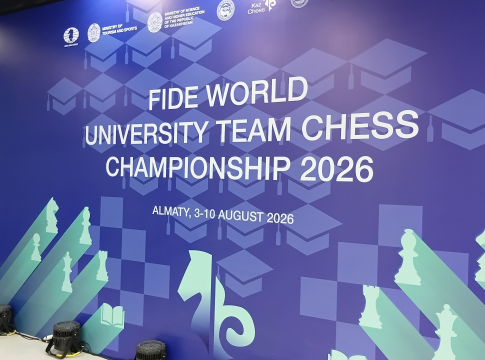
Following a highly competitive online qualification process, 16 university teams from around the world were invited to play the inaugural FIDE World University Team Chess Championship, a major event currently taking place at the Al-Farabi Kazakh National University in Almaty.
As many as 79 teams from 49 countries attempted to make it to Almaty, proving that chess continues to thrive in a world increasingly defined by higher-tech pastimes.
Viswanathan Anand, FIDE Interim President, summed this up:
“Some of the participating institutions have had chess clubs for more than 150 years, showing how deeply the game is rooted in university life.
“For many of the players, Almaty will be their first FIDE world championship, and I hope they enjoy every moment of the experience and return home feeling proud of what they achieved together as a team.”
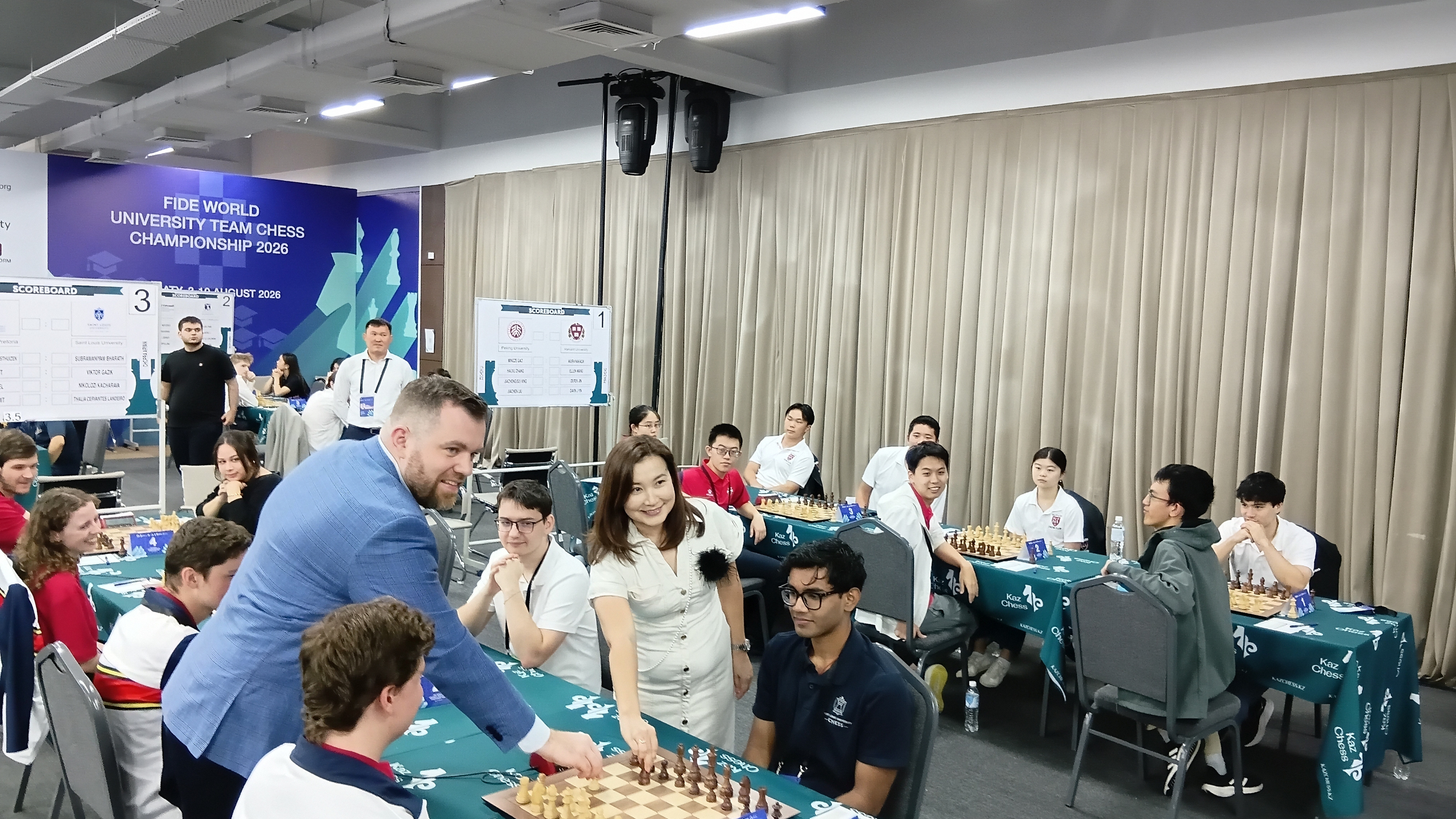
Players from leading universities lock horns in the major global tournament which runs from 3-10 August, 2026, with no clear favourite having yet emerged after a competitive series of opening round-robin matches. The teams are divided into four groups of equal strength and will play in a team-versus-team format, after which the top two teams head to the playoffs to compete for a share of the €50,000 prize fund.
To say leading universities is no overstatement, with Oxford, Cambridge, and Harvard represented, although interestingly they entered the contest after receiving a wild-card invitation, and are not the highest-rated teams here this week.
One of the Cambridge representatives is Emilia, from Poland, who is studying engineering, and amazingly, hadn’t played chess seriously until recently.
“I played a lot as a child, but I’ve been devoted to my studies for most of my life. I got back into chess when I went to Cambridge.”
The players to watch are from Saint Louis University (USA) whose combined rating is 2,577, but they will be up against the Ural State Mining University (Yekaterinburg) at 2,514, and the University of Texas at Dallas (USA) with 2,441.
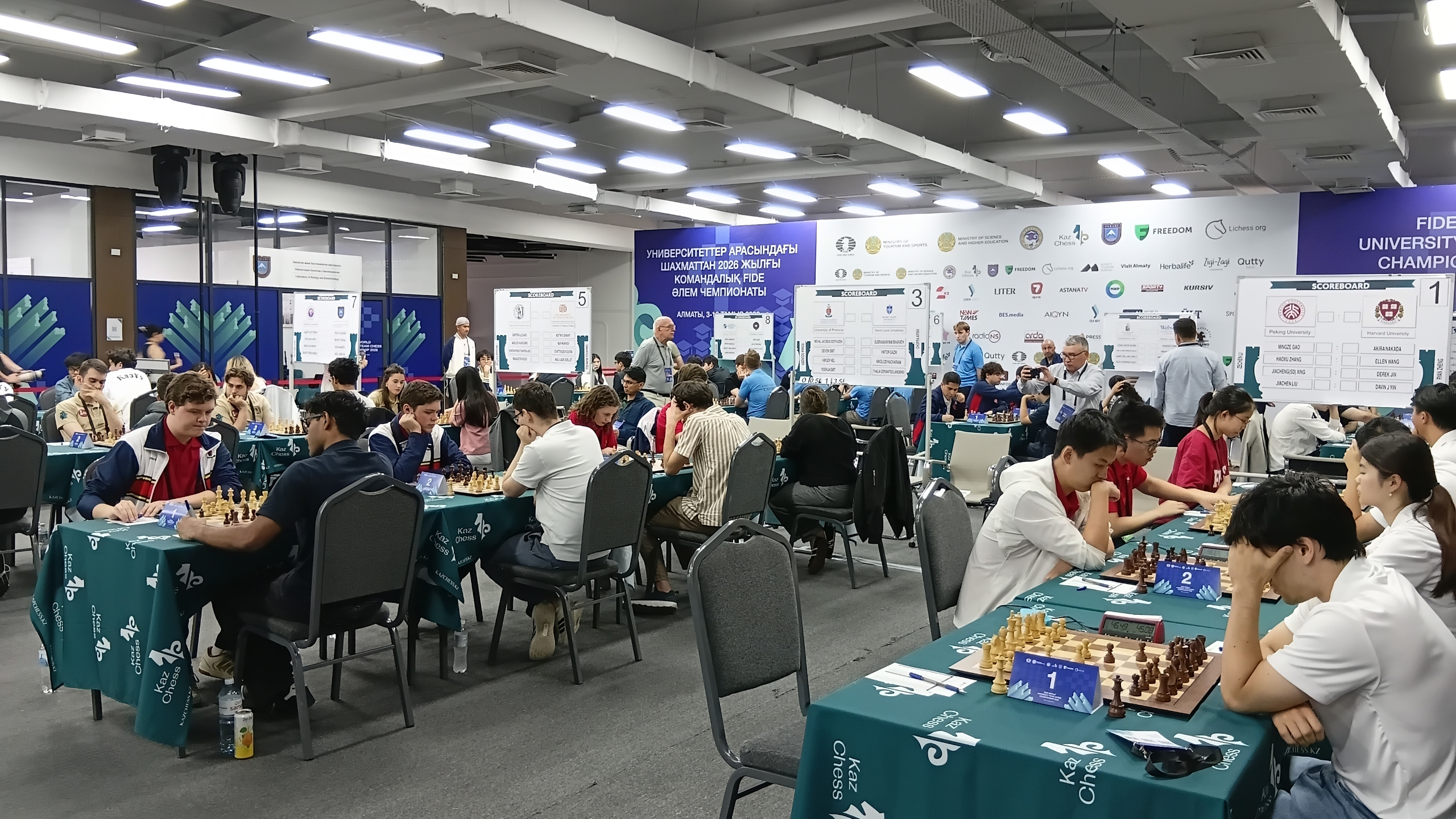
The automatic qualifiers include two universities from St Louis in the USA, both the aforementioned, and Webster University, for whom Francesco Sonis plays, an Italian who boasts one of the highest ratings in student chess worldwide.
“I won my game, but sadly the team didn’t come out on top today. We go again tomorrow with higher hopes.
“As for individual tournaments, my 2,500 rating stands me in good stead, but I will have to be at my best to beat some of these players.”
Among the Kazakhstani universities taking part, the hosts, the Al-Farabi Kazakh National University qualified by placing high in the preliminaries, but according to their captain, Serikbay Shyngyskhan, they haven’t had it all their own way so far.
“We’ve come up against some top players and haven’t won all our matches, but we are still in the hunt.”
Choosing Almaty as the venue has paid dividends, although those taking part are playing on the back of long flights and haven’t had chance to enjoy the city yet. While the majority are away for the summer break, 236,000 students are based in the southern Kazakh metropolis for nine months of each year. Student life in Almaty is vibrant, something Timur Turlov, President of the Kazakhstan Chess Federation agrees with:
“Almaty is the ideal venue for this story. As the country’s largest student hub, it speaks the language of youth.”
Deputy Mayor of Almaty, Nurlan Abdrakhim, attended the opening ceremony and echoed those words.
“I am confident that this championship will be a bright event for the city, and its participants will take home not only sporting achievements, but also wonderful impressions of Almaty.”
Timur Turlov was also very keen to state how important chess was for young people more generally:
“The development of student chess is one of our top priorities, because it is in the university environment today that ties and acquaintances are forged that go far beyond the chessboard and continue in science, education, and joint projects around the world.”
Speaking to captains and players made it clear that they share this view, win or lose. Several of them reported losing but loving the experience; two captains said they were disappointed with results but delighted to be at the tournament.
The South Africans, representing the University of Pretoria were noticeably upbeat, despite being one defeat away from elimination. Their 1,920-rated player, Devon Smit, was full of smiles when he explained that it had been a great experience, and his team-mate Michal Ooosthuizen only added to that with evident enthusiasm for both chess and the new tournament, which many expect to become a fixed part of the FIDE calendar.
Also taking place at the same venue was an international challenge between a Kazakhstani children’s team and a rest-of-the-world side, and this is seen as just as important as the student game, given that children are the future of the game. Deputy Prime Minister and Minister of Culture and Information of the Republic of Kazakhstan, Aida Balayeva, delivered a video address to the participants, saying that:
“Head of State Kassym-Jomart Kemelevich Tokayev pays special attention to the development of chess, viewing it not only as a sport, but also as a crucial part of intellectual culture, education, and the upbringing of the younger generation.”
FIDE Special Tasks Director, Akaki Lashvili, from Tbilisi in Georgia, presided over the awards ceremony for the young players, with medals handed to the winners and runners-up, the Kazakhstan team taking two of the four gold medals up for grabs. A host of proud parents from several countries then added to the enthusiastic applause of the many people in the venue.