
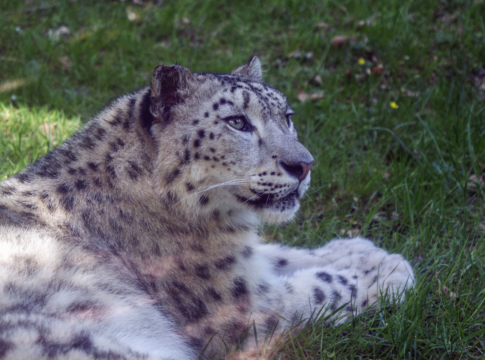
The Astana Times is today reporting that Kazakhstan’s snow leopard population is moderately resurgent, with numbers doubling over the last few decades.
While, numerically, this is not a conservation success story on a par with that of the saiga, the significance of this news to the region cannot be underestimated, on so many levels.
Since July 1993, the coat of arms of the city of Almaty, which was back then the capital of the republic, has featured a snow leopard, not merely in the sense that it is visibly prominent but in that it encapsulates the culture and history of the city. Wikipedia can take over here for a moment:
The coat of arms of the city of Almaty is a base in the form of a round eastern shield, in the foreground of which is snow leopard depicted holding a branch with eight apple-tree flowers in its mouth, which personify eight districts of the city of Almaty.
Given the inseparable association of the city and the big cat, the steadfastness of the majestic feline and its refreshing bouncebackability (yes, that’s a real word) is exciting not only scientists, but also regular inhabitants of the southern metropolis, with tracking able to verify the existence of up to 200 ‘ghosts of the mountains’.
Astana Times continued to say that tracking projects commenced in the Altai Mountains in eastern Kazakhstan with another leopard fitted with a satellite collar on 19 October 2026, enabling experts to monitor its movements and gain valuable insights into its life.
The male leopard in question was named Altai and the data his collar provided enabled those studying him to understand not only his territory and movements, but to limit human encroachment into that zone.
Altai is not the first snow leopard to be tracked in this way, rather, the 16th since 2021 and this initiative has been a great success, firstly because we are able to understand such an elusive creature so much better, secondly because their natural habitat is easier to protect now knowing the regions these creatures typically inhabit.
International Snow Leopard Day, observed every year on 23 October, dates back to 2013 when a major WWF conference adopted the Bishkek Declaration at the first Global Snow Leopard Conservation Forum in Kyrgyzstan. It received the signatures of 12 countries: Afghanistan, Bhutan, China, India, Kazakhstan, Kyrgyzstan, Mongolia, Nepal, Pakistan, Russia, Tajikistan, and Uzbekistan, all of whom have a genuine interest in the matter.
Threats to the animal include habitat loss and fragmentation, climate change, human-wildlife conflict, and illegal wildlife trade, but a story from December 2022 when a rescued snow leopard died having swallowing a plastic bag while still in the wilds, reminds people that the ecosystem is often very fragile where human carelessness encroaches.
Altai himself is not likely to wander as far as Almaty, given the distance he would have to cover, but recent years have seen stories emerging from hikers who have encountered other snow leopards in the mountainous area not far from the city.
Tengri News has run such stories, recounting how in the Big Almaty Gorge, as well as the Katon-Karagay National Park, sightings have become more common. While those witnessing the cats are said to have been more entranced than anything, park rangers have needed to step in to maintain a distance between tourists (and sometimes their drones) and the snow leopards, often while the latter were feeding.
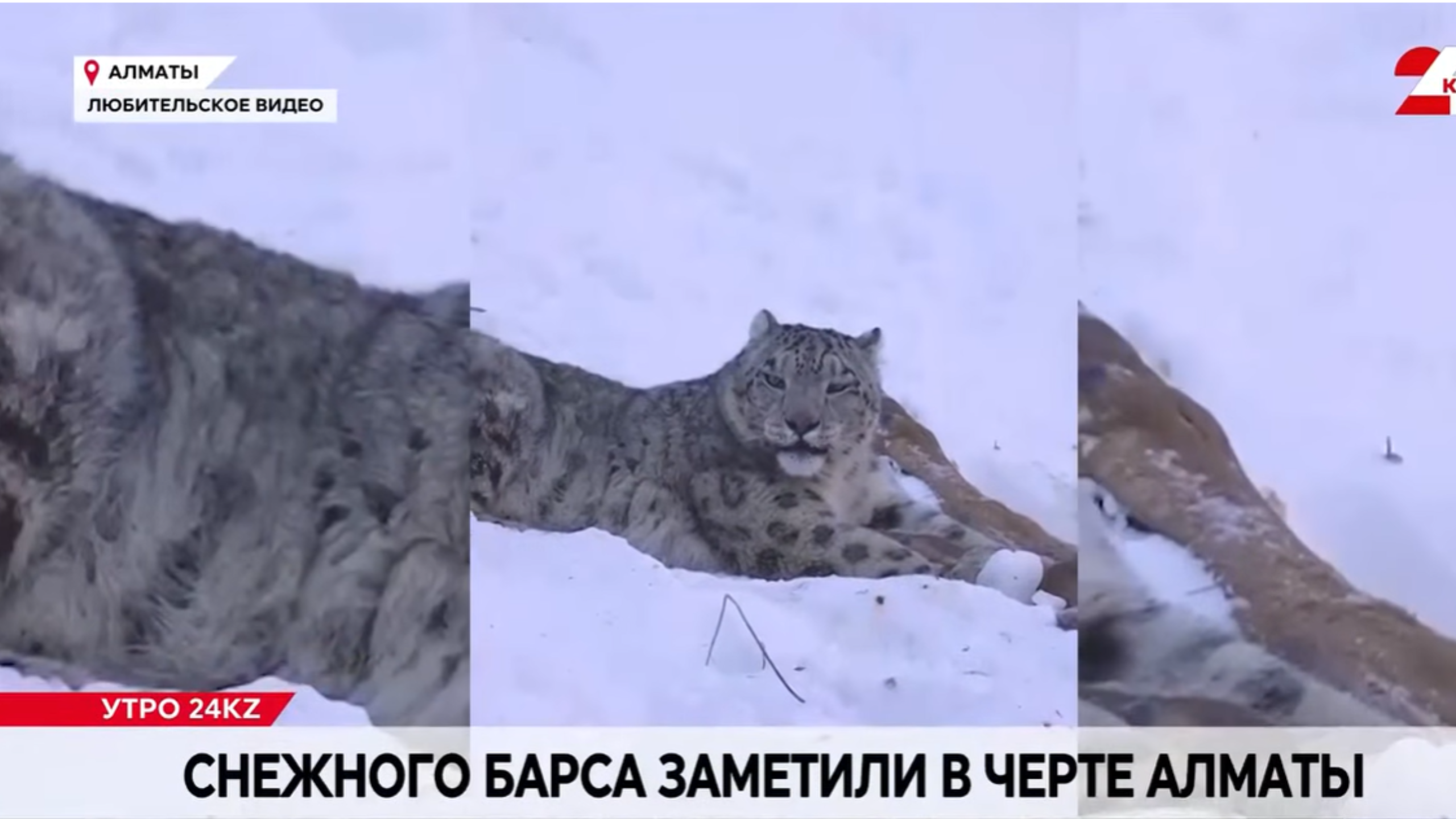
One such cat had strayed to a lower altitude and remained there for three days, finally needing to be returned to a higher zone better suited.
One local man, a keen hiker, reported how he came across a snow leopard while out on a walk. Out of respect for the creature, he kept his distance and later reported it to the authorities. Keen to ensure that the cat would be left alone, he also declined to disclose the exact location to others, stating only that it was near Almaty.
“It was beautiful. And you know, it had a meow like a house cat. I have never seen anything so beautiful out in the wilds. I never thought I would see one, and I have been walking in this area for 40 years.”
UNDP also reports increasing numbers of snow leopards in Kazakhstan and the various cross-border regions, adding that this is because of concerted efforts on the part of local authorities and people. The restoration of the ecosystem and the enhanced protection of wildlife, coupled with monitoring and detailed study of the creatures is also a significant factor.
Thanks to the introduction of protected areas, on which an estimated 70% of these leopards live, their population is not only recorded as stable, but steadily increasing.