
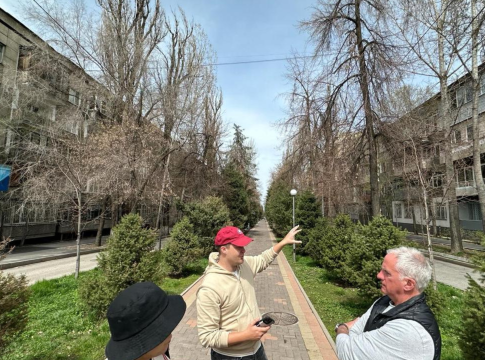
It’s not unusual for foreigners in Kazakhstan to receive offers of help from local people whose hospitality is often in evidence (even guests who’ve been here for decades).
Perhaps, though, there are expats over here who don’t need the assistance; many foreign citizens more than proficient in Kazakhstan life, be it in the cities or outside the confines of even the largest population centres.
One guy, Dennis Keen, from California, has long since graduated from needing to ask for directions, right to the extent that he is widely regarded as an authority on the southern city of Almaty, until 1997, the capital of the Republic of Kazakhstan. Even local people have started to do his walking tours of their own city, many long-term residents finding that they learn more about parts of Almaty than they did in half a century living here.
Walking Almaty is a highly-rated five-star option for tourists and locals alike, and while to appreciate what it offers, it would be better to join it on one of its many itineraries, the story behind it is worth telling in itself, which is why saqtimes.kz met up with Dennis to learn it from him.
First Time in Almaty
When still at school, Dennis was considering his options and, after discussion with his parents, decided that a spell studying abroad would be a good experience and solid preparation for college. This led him, in 2005, when 17, to Almaty, where he stayed with a host family and took daily lessons in both Kazakh and Russian.
By his own admission, growing up in the suburbs of Los Angeles hadn’t fully prepared him for a spell living in a post-Soviet state, although the early culture shock soon subsided and Dennis found his walking feet and gradually got to know the city and surrounding area, marking his path on a map to avoid duplicating routes.
“I went back and finished high school and took Russian there too, and ended up majoring in Linguistics with a focus on that language.
“I then got a Fulbright scholarship and applied to go to Kyrgyzstan, where I spent a year researching eagle hunting. I was based in Bishkek, but my field study took me to the Issyk Kul region quite regularly. This was back in 2010-2011.”
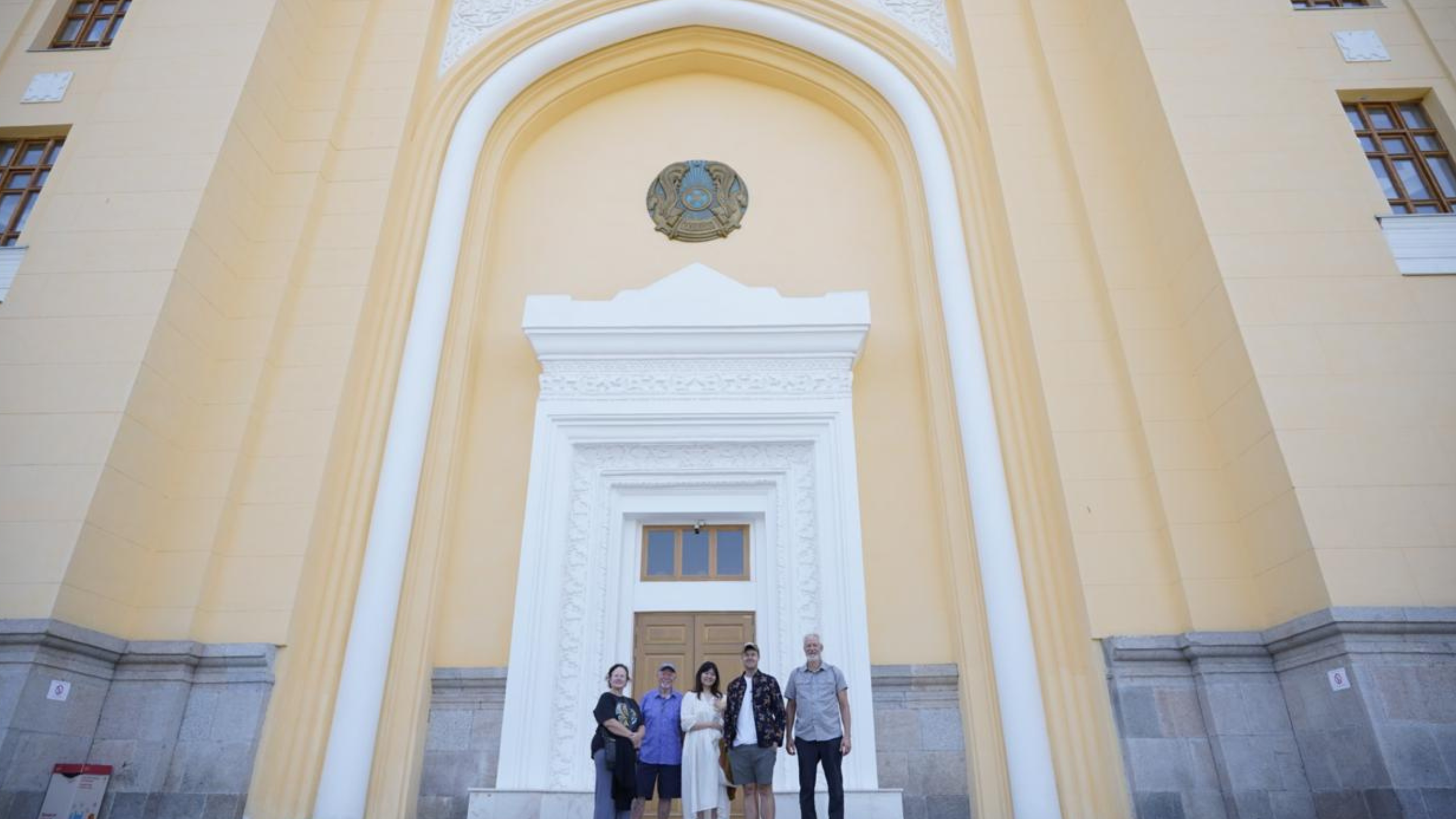 Although even some intrepid tourists might not have more than a passing interest in eagle hunting, for some it would be the opportunity of a lifetime, and Dennis detailed what he gained from that year, although he also explained that since tourism picked up in Kyrgyzstan, the tradition has changed from being more recreational to perhaps a form of entertainment, not his exact words, but it stands to reason that introducing it to outsiders has become more for show than for survival.
These days, people coming over to Central Asia are better prepared, able to draw on the experience of people such as Dennis Keen, plus check the scene out online, but back in 2005, it was harder to do this.
“I suppose I knew more about the region than the average American, because I was always curious about history and geography, but it wasn’t easy to get the full picture before I flew out.
“My first impressions of Kazakhstan? Well, that happened on two levels because my very first trip was, as I mentioned, on the back of applying for a place on a programme which involved living with a host family and learning the languages.
“But later on in 2013, I came over to study at KIMEP armed with far greater understanding of the scene, and I have been based here ever since.
“My first impressions in each year were different. 2005 was a big culture shock for me, and here I was on the other side of the world in a very different urban landscape, living in a Soviet-period apartment building near Kok Tobe. It felt like a strange parallel universe at times.”
The same building is still there, and Dennis was amused to recount how the shower had lights and played music, perhaps not something out of the reach of your average Californian, but not something they typically go for.
The language barrier also got in the way sometimes. Dennis is by now fluent in both Russian and Kazakh and speaks both with a soft, endearing American accent. In the case of the latter, he remains one of only a handful of foreigners to have grasped the ancient Turkic language, not yet to feature equally alongside Russian in daily Almaty life.
The Birth of Walking Almaty Guided Tours
His strolls around the city, and his dedication to educating himself about what he was looking at, firstly led to a blog, then to an Instagram page, and finally to organised tours, after visiting couch-surfers had suggested that he offer it as a service, asking:
“Have you thought about running guided tours?”
TripAdvisor was the final piece in the Walking Almaty jigsaw, and its service is now sought-after; information also available on their own website, walkingalmaty.com
Their most popular tour is around an area of Almaty called the Golden Quarter, in Soviet days perhaps the most exclusive area of the city and still regarded as a desirable place to live.
Added to that now are tours of what Walking Almaty calls the Lower Quarter, as well as Kompot, Malaya Stanitsa, which even locals haven’t fully explored, despite knowing them.
“We go to the bazaars, like Barakholka, but the Golden Quarter is the most popular of our options.”
Kompot is in some ways a surprising choice for a city walk because there are few out-and-out tourist attractions, but as soon as you get across the river, Dennis explains that you are transported to what feels like another world.
“We visit Kasteyev’s house (the famous artist), plus call in at a tuberculosis hospital museum, but mostly Kompot is an atmospheric tour, with some stories thrown in for good measure.”
Dennis doesn’t only guide regular tourists, however. His clients have included diplomats and visiting dignitaries, often officials who are visiting from Astana. At the other end of the scale – if there is such a thing – are the budget-conscious backpackers, although there are fewer of those, partly because of the finances but also because these types of travellers usually prefer to look after themselves.
“More often than not, our guests would be middle-aged, plus a lot of retirees. For sure, most of them are native English speakers, from the UK, USA, Australia, and Canada, but we get continental Europeans, too.
“If there is one thing they have in common, apart from being lovely people, as well as educated, it’s that they are all well-travelled, inevitably. It’s not common for people to make Kazakhstan their first trip abroad.”
I was a little surprised, without knowing why, to hear Dennis say we, when referring to Walking Almaty. Thinking he might have some admin support in the background of what is by now a thriving business, I felt led to ask.
“Ah, no, I have a couple of colleagues who stood out when they did my tourist guide training course, Almaty Guide School, so I invited them to join me, and they are already prized assets on the programme.
“Others who trained with me work for other companies, and this was perhaps my expectation when running the course, but my star students remained with me.”
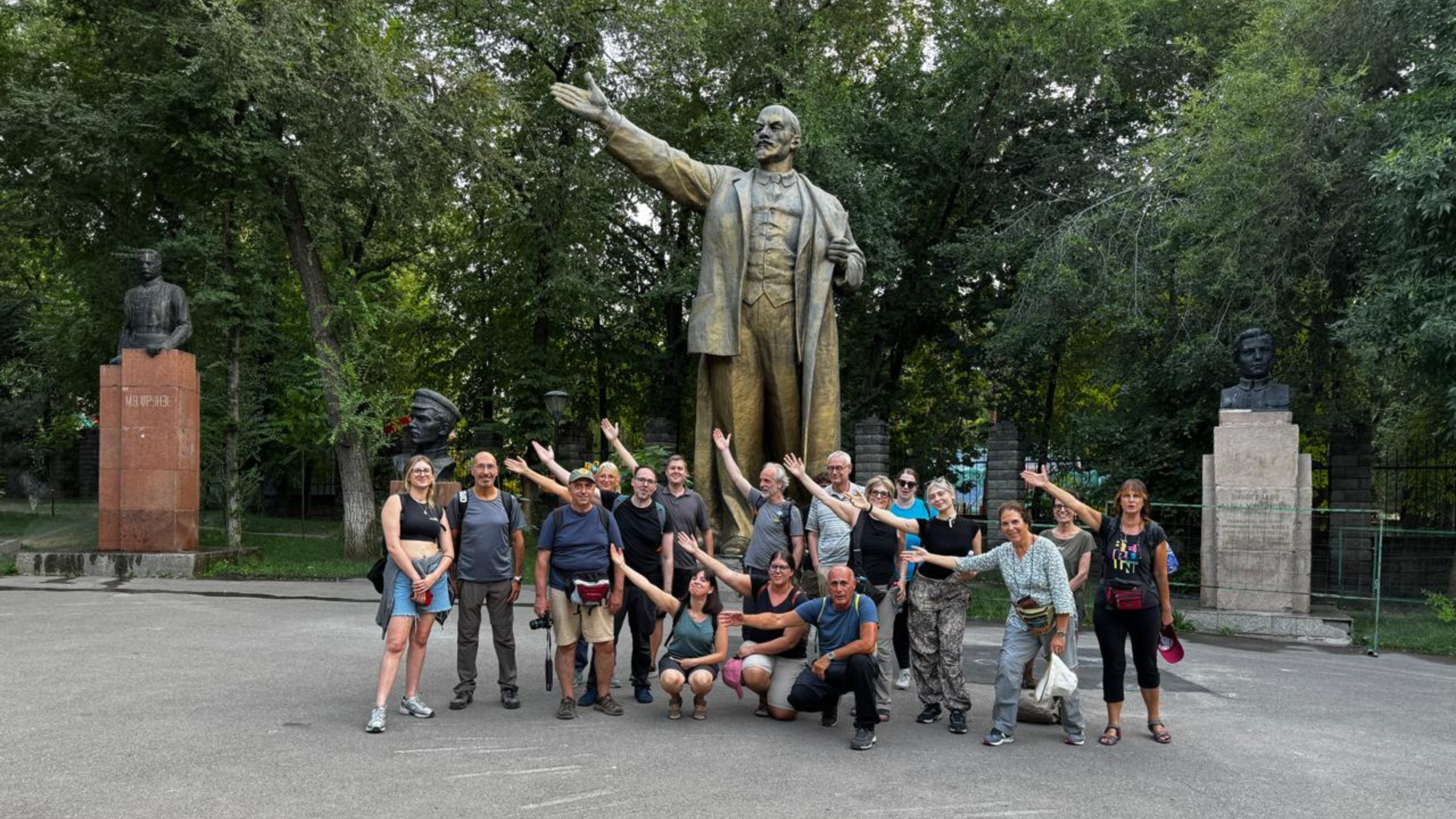 Nobody comes eleven thousand miles across the world and ends up teaching some of the locals about their own city without having things to tell them. For over a decade now, Dennis Keen has been a passionate student of not only Almaty but Central Asia, and is grateful to a few local experts for filling him in on a few missing details.
“Tour guides need to tell stories, not just show people the buildings, so it pays to have plenty to say. Research is key, knowing the details and facts behind those stories. All that we tell is built on the knowledge shared by local experts such as Yevgeniya Morozova, a tour guide and historian.
“I’ve learned a lot from her, plus from the urbanist community.”
Anel Moldakhmetova runs ArchCode Almaty, and she has also been a source of info, but Dennis finds that talking to neighbours is worth just as much, in many ways.
By now a father of two, he often makes family trips back to California, but since arriving in 2013, the Keens have mainly been based in Almaty.
About five years ago, he helped initiate a programme to teach Kazakh at the University College of Los Angeles (UCLA), not always tailored to people who plan to come to Kazakhstan, but as a complement to the Russian-language courses whose students now often do come here rather than fly out for full-immersion study in Russia itself. The course also includes aspects of Kazakh culture and history, and as enrolment is open, it was a popular sign-up with dozens of curious, as well as committed, students.
Not one to stand still, Dennis has plans for Walking Almaty not only within the city itself but to places further afield, perhaps the ever-popular Charyn Canyon, set to be the destination of choice for many of his clients. He also collaborates with a company called Dostar Trips, which focuses on tours around Almaty, with whom he plans to take tourists to Charyn, as well as Kolsai Lake, Altyn Emel, and Zharkent, a town well east of the city towards the Chinese border.
“I also run trips to the Semipalatinsk [nuclear] test site in conjunction with Saiga Tours, the next one is coming up as soon as next week.”
Ever full of surprises, this latter offering might be the icing on the Walking Almaty cake, at least so far.